
Paternity Test Without DNA: What Are the Options?
People may look for a paternity test without DNA because the alleged father is unavailable, does not consent to testing, or cannot provide a sample. The important distinction is that a test may sometimes be completed without a sample from the alleged father—but a reliable biological paternity test still depends on analyzing DNA. There is no conventional test based on appearance or blood type that can conclusively prove paternity.
Can Paternity Be Determined Without DNA?
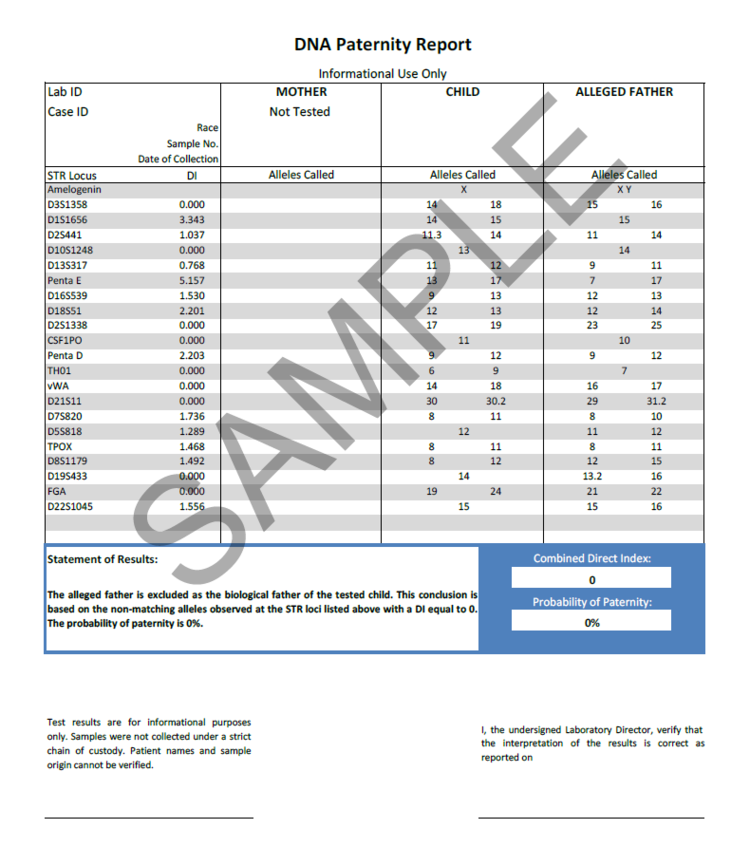
Not with scientific certainty. DNA testing compares genetic markers among a child and potential biological relatives. Without DNA from the alleged father, a laboratory may be able to examine samples from certain relatives, but the results are generally less direct and may be less conclusive than testing the child and alleged father together.
Other information—such as a person’s appearance, family history, blood type, or conception dates—may offer context, but it cannot establish paternity on its own.
Blood-Type Testing: Why It Is Not Enough
Blood-type testing was once used to assess paternity. In some cases, a blood-type combination could rule out a man as the biological father. However, many unrelated people share the same blood type, so a match cannot prove that someone is the father. Modern DNA testing is far more informative and is the standard method for biological paternity testing.
Testing When the Alleged Father Is Unavailable
If the alleged father cannot provide a sample, a laboratory may offer a kinship test using DNA from close relatives. Depending on the circumstances, testing may involve:
- Grandparentage testing: The child’s alleged paternal grandparents are tested to assess whether they are biologically related to the child in a way consistent with the claimed relationship.
- Siblingship testing: The child and a known biological child of the alleged father are tested to assess whether they may share a biological parent.
- Testing other relatives: A laboratory may evaluate samples from relatives such as a brother or sister of the alleged father.
These tests still analyze DNA. They may not provide the same level of certainty as a direct test with the alleged father, and the usefulness of the results depends on which relatives are available and the family relationships involved. Ask an accredited laboratory to explain the test’s limits before submitting samples.
Legal Paternity Is Different From Biological Paternity
In some situations, paternity may be established legally without a DNA test. For example, a person may be recognized as a legal parent through a voluntary acknowledgment, a court order, or applicable parentage laws. Legal parentage and biological parentage are related but distinct questions; the rules and consequences vary by location.
If the result may be used for child support, custody, inheritance, immigration, or another legal matter, find out what type of test and collection process the relevant court or agency will accept. At-home testing may not meet legal requirements because the identities of the people tested and the handling of samples may not be formally verified.
What About Paternity Tests Based on Appearance?
Facial resemblance, eye color, hair color, and other physical traits cannot reliably determine paternity. Children inherit traits from both parents, and many traits are shared by people who are not closely related. Photographs and visual comparisons are not substitutes for genetic testing.
Choosing the Right Next Step
If direct testing is not possible, contact an accredited paternity-testing laboratory and describe which family members are available to participate. Ask whether the lab offers grandparentage or other kinship testing, what the results can establish, and whether the test meets your needs. For a legal dispute, consult a qualified attorney or the appropriate court or agency before testing.
In short, there is no dependable biological paternity test that works without DNA. When the alleged father cannot be tested, DNA from close relatives may provide an alternative, while legal parentage may sometimes be determined through processes that do not involve genetic testing.
Understanding Paternity: 8 Considerations Beyond DNA Testing
- No non-DNA method can reliably confirm biological paternity.
- Blood type comparisons may rule out paternity, but cannot prove it.
- Physical resemblance is not reliable evidence of paternity.
- Family records and timelines can provide context, not certainty.
- Ask a doctor or genetic counselor about your options.
- For legal questions, consult a family-law attorney.
- A court may require an accredited DNA test to establish paternity.
- Respect everyone’s privacy and follow consent requirements.
No non-DNA method can reliably confirm biological paternity.
No non-DNA method can reliably confirm biological paternity. A person’s appearance, blood type, family history, or estimated conception dates may offer clues, but none can prove that someone is a child’s biological father. When direct testing isn’t possible, a qualified laboratory may be able to assess DNA from close relatives, though those results can be less conclusive than testing the alleged father directly.
Blood type comparisons may rule out paternity, but cannot prove it.
Blood type comparisons can sometimes rule out paternity when a child’s blood type is genetically incompatible with the alleged father’s. However, many people share the same blood type, so a compatible match does not prove a biological relationship. Blood-type testing is therefore limited to possible exclusion and cannot replace a DNA paternity test for confirming paternity.
Physical resemblance is not reliable evidence of paternity.
Physical resemblance is not reliable evidence of paternity. A child may look like a relative—or share common features such as eye color, hair color, or facial shape—with someone who is not their biological parent. Families may also overlook or misinterpret similarities and differences. Appearance can raise questions, but it cannot confirm or rule out paternity; a DNA test is needed for reliable biological evidence.
Family records and timelines can provide context, not certainty.
Family records and timelines can help clarify a paternity question, but they cannot confirm biological parentage. Birth certificates, letters, photographs, and information about when a possible conception occurred may provide useful context or help guide next steps. However, records can be incomplete, dates may be uncertain, and family resemblance or personal accounts are not proof. When certainty is needed, consult an accredited testing laboratory about DNA-based options, including testing close relatives if the alleged father is unavailable.
Ask a doctor or genetic counselor about your options.
If the alleged father is unavailable or unable to provide a sample, ask a doctor or genetic counselor about your options. They can explain whether testing close relatives—such as the alleged father’s parents or other children—may help assess biological relationships, discuss the limits of those tests, and guide you toward an accredited laboratory. If the result may be used for a legal matter, ask which testing process will meet the relevant requirements.
For legal questions, consult a family-law attorney.
For legal questions about paternity, consult a family-law attorney in your area. An attorney can explain how parentage is established where you live, whether DNA or kinship testing may be relevant, and what steps to take if the alleged father is unavailable. If you need results for a court or government agency, ask what testing process and documentation will be accepted before arranging a test.
A court may require an accredited DNA test to establish paternity.
A court may require an accredited DNA test to establish paternity, especially when the results will be used in a legal matter such as child support or custody. At-home tests or informal alternatives may not meet the court’s requirements because they may not verify each person’s identity or document how samples were collected and handled. Check with the court or a qualified attorney before arranging testing to confirm which laboratory and testing process will be accepted.
Respect everyone’s privacy and follow consent requirements.
Respect everyone’s privacy and follow all consent requirements when considering paternity testing. Make sure each participant understands what the test involves, how samples and results will be handled, and who may access the information. Do not collect or submit someone’s DNA without proper permission, and check local laws and testing-lab policies, especially when a child is involved. If the results may be used in a legal matter, seek guidance on the required consent and testing procedures before taking any samples.