
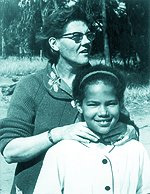
Sandra Laing and the Question of a Paternity Test
Sandra Laing’s story is often discussed in connection with paternity testing because her appearance led people to question how she could be the daughter of two parents classified as white in apartheid-era South Africa. But the central issue in her story was not a publicly established finding that her father was someone else. It was the way South Africa’s racial classification system treated her.
Who Was Sandra Laing?
Sandra Laing was born in 1955 in South Africa to Abraham and Sannie Laing, an Afrikaner couple classified as white. Sandra’s appearance differed from what officials expected of a white child. Under apartheid, that difference brought intense scrutiny and affected her schooling, legal status, and family life.
South Africa’s Population Registration Act required people to be classified by race. Officials relied on factors such as appearance, ancestry, and social acceptance—not on a simple, definitive genetic test. Sandra was classified as “coloured,” a category used by the apartheid government, and her parents challenged that classification. Her case illustrates how racial categories were imposed and enforced, rather than scientifically precise descriptions of a person’s identity.
Was There a Paternity Test?
Stories about Sandra Laing sometimes refer to tests or examinations connected with her parentage. However, accounts do not consistently establish that she underwent a modern DNA paternity test, or that a DNA result proved or disproved Abraham Laing’s paternity. Historical references to blood tests, where reported, should not be treated as equivalent to today’s DNA testing.
The important distinction is that questions raised about Sandra’s appearance were not the same as proof of non-paternity. Her family’s public struggle centered on her racial classification and the consequences of apartheid policy. Appearance alone cannot establish whether someone is biologically related to a parent.
Why the Story Still Matters
Sandra Laing’s experience shows the harm caused when governments use rigid racial categories to define people and shape their rights. It also highlights why claims about family relationships should be handled carefully: historical accounts, appearance, and old testing methods cannot substitute for reliable evidence.
When discussing Sandra Laing and paternity testing, the most accurate conclusion is that her story is primarily about racial classification under apartheid. Publicly available accounts do not provide a clear basis for claiming that a modern DNA paternity test resolved her parentage.
7 Benefits of DNA Paternity Testing in the Context of Sandra Laing’s Story
- DNA testing can clarify biological parentage.
- Modern tests are more reliable than appearance-based assumptions.
- Testing can help resolve uncertainty for families.
- Results may provide useful information for medical history.
- Accurate evidence can challenge unsupported claims.
- The topic highlights the limits of racial classification.
- Sandra Laing’s story encourages careful discussion of identity and ancestry.
Sandra Laing Paternity Testing: Four Key Limitations of the Available Evidence
- Historical accounts of testing are inconsistent.
- No publicly confirmed modern DNA result is established.
- Appearance alone cannot prove or disprove paternity.
- Apartheid-era racial classifications were not reliable evidence of parentage.
DNA testing can clarify biological parentage.
One potential benefit of a DNA paternity test is that it can help clarify whether a child is biologically related to an alleged parent. In discussions of Sandra Laing’s story, this point should be kept separate from the apartheid-era racial classification that shaped her life: biological parentage and racial identity are not the same question, and publicly available accounts do not establish that a modern DNA test resolved her parentage.
Modern tests are more reliable than appearance-based assumptions.
One important advantage of a modern paternity test is that it can provide far more reliable evidence of a biological relationship than assumptions based on a person’s appearance. Physical traits vary widely within families and populations, so they cannot confirm or rule out paternity on their own. DNA testing compares genetic markers to assess whether a claimed biological relationship is supported, offering a clearer basis for answers than visual judgments. In discussions of Sandra Laing’s story, this distinction matters: appearance-based conclusions should not be mistaken for proof of parentage.
Testing can help resolve uncertainty for families.
Paternity testing can help resolve uncertainty for families by providing clear genetic information when parentage is in question. In discussions of Sandra Laing, however, it is important not to assume that a modern DNA test was performed or that testing established her parentage; her story is chiefly documented in the context of apartheid-era racial classification.
Results may provide useful information for medical history.
If a paternity test establishes a biological relationship, the result may help someone gather family medical history, such as information about inherited conditions or health risks. That information can be useful to discuss with a healthcare professional, though a paternity test does not diagnose medical conditions. In Sandra Laing’s case, this is a general potential benefit of DNA testing—not evidence that a modern paternity test was performed or that its results clarified her parentage.
Accurate evidence can challenge unsupported claims.
Reliable DNA testing can provide clear evidence when questions about biological parentage arise, helping families distinguish verified facts from assumptions based on appearance or rumor. In discussions of Sandra Laing, though, it is important not to imply that a modern paternity test definitively settled her parentage; the historical accounts available do not establish that such a test was performed.
The topic highlights the limits of racial classification.
Sandra Laing’s story highlights the limits of racial classification by showing that appearance and government-assigned categories cannot reliably define a person’s ancestry or family relationships. The questions surrounding her paternity also underscore that assumptions based on skin color are not proof of biological parentage; reliable evidence, such as properly conducted DNA testing, is needed to answer that question.
Sandra Laing’s story encourages careful discussion of identity and ancestry.
Sandra Laing’s story encourages thoughtful discussion of identity and ancestry by showing that appearance alone cannot define a person’s background or family relationships. It also highlights the importance of approaching questions about parentage with sensitivity, relying on credible evidence rather than assumptions, and recognizing that identity can involve personal, cultural, and historical dimensions.
Historical accounts of testing are inconsistent.
One challenge in discussing a paternity test in Sandra Laing’s case is that historical accounts of testing are inconsistent. Sources may describe examinations or blood tests differently, and those procedures should not automatically be equated with modern DNA testing. As a result, it can be difficult to determine exactly what tests were performed, what they were intended to establish, or what conclusions they supported. This uncertainty calls for care when making claims about whether a test confirmed or disproved her biological parentage.
No publicly confirmed modern DNA result is established.
One limitation in discussions of Sandra Laing’s paternity is that no publicly confirmed result from a modern DNA test appears to be established. Historical reports about examinations or blood tests should not be presented as equivalent to contemporary DNA analysis, and they do not provide a clear, publicly verified answer about biological parentage. This means claims that a paternity test definitively proved or disproved her father’s relationship should be treated cautiously.
Appearance alone cannot prove or disprove paternity.
Sandra Laing’s story illustrates an important limitation of judging paternity by appearance: physical traits can vary widely within families, and a child may not look like either parent. Resemblance—or a perceived lack of it—cannot prove or disprove a biological relationship. Treating appearance as evidence can lead to harmful assumptions, as well as confusion about a story shaped largely by South Africa’s apartheid-era racial classification system. Only reliable genetic testing can provide scientific evidence of biological paternity.
Apartheid-era racial classifications were not reliable evidence of parentage.
One important limitation in discussions of Sandra Laing’s paternity is that apartheid-era racial classifications were not reliable evidence of biological parentage. Those classifications were based on discriminatory rules and judgments about appearance, ancestry, and social acceptance—not modern DNA analysis. As a result, Sandra’s racial classification could not by itself prove or disprove who her biological parents were.